
Prospecting method: Effective strategies to boost your sales
Learn the prospecting method to transform your B2B approach and maximize your results with the help of a Oliverlist B2B prospecting agency.

Concretely, what is a prospecting method? It's simply the system you put in place to find new customers and convince them to work with you. Forget the image of Épinal as a salesman who makes a series of cold calls without really knowing who he is talking to. Today, an approach that works is based on clear strategies, tools, and processes to generate opportunities in a predictable way.
What is an effective prospecting method?
Thinking about your prospecting method is not just ticking off a to-do list. It's much more than that: it's building the real growth engine for your business.
Imagine a great chef. He doesn't just throw random ingredients into a saucepan hoping for a miracle. No, he follows a precise recipe, chooses quality products and masters each step to ensure an exceptional dish, every time. Your prospecting method is your recipe for commercial success. It transforms an activity that is often perceived as a poker game into a well-oiled mechanism.
In B2B, successful companies are no longer looking for “lucky luck”. They are building a system that perfectly aligns their teams, tools, and messages to generate growth that is both predictable and sustainable.
Today, adopting this systematic approach is no longer an option. Decision-makers are drowning in solicitations. Without a structured approach, your efforts will be lost in the ambient noise. A well-thought-out method ensures that each action has a specific purpose and serves your final objective.
The pillars of a structured approach
A good prospecting method is based on several pillars that work together. If one of them is missing, the whole building becomes wobbly, even with the best sellers or the most expensive tools.
Here are the essential foundations:
- A detailed understanding of your market: It's not just about knowing your customers' industry. You need to understand their real challenges, their goals, the jargon they use, and most importantly, what drives them to seek a solution like yours.
- Clear and measurable goals (KPIs): Without a destination, it's impossible to trace a route. Set specific goals, such as “getting 20 qualified appointments per month” or “aim for a response rate of 5% on our email campaigns.” This will allow you to know if you are on the right track and to adjust your situation.
- Surgical targeting: You need to know exactly Whom you are talking to. Defining your Ideal Customer Profile (ICP) is not a suggestion, it is a golden rule. This allows you to personalize your message and focus your efforts where they will have the most impact.
- Choosing the right channels: Your prospects are not all in the same place. Your method should clearly define where to find them: by email, on the phone, on LinkedIn? And above all, how to combine these channels to reach them at the right time, on the right platform.
- Appropriate processes and tools: How are prospects who show interest managed? What tools do you use to automate tasks that don't add value? A well-established process frees up your salespeople so they can focus on what matters most: conversations with your future customers.
By combining these elements, you are not just prospecting. You are building a real advantage over your competitors. Each email, each call is part of a well-thought-out strategy that increases your chances of success tenfold.
First of all, for a prospecting method works, you need a plan. It's as simple as that. Without a clear roadmap, even the best salespeople find themselves navigating by sight, wasting valuable time and energy. A well-thought-out prospecting plan is what turns a disorderly commercial turmoil into a real machine for generating revenue in a predictable way.
Think of it not as a rigid document that will gather dust, but rather as a dynamic GPS that guides every action, from the first contact search to the signing of the contract. This is the guarantee that your entire team is moving in the same direction, with common goals and a shared vision of the steps to follow.
Define your ideal client with surgical precision
The first step, and by far the most crucial, is to define your Ideal Customer Profile (ICP). Too many companies make the mistake of remaining vague, for example by targeting “SMEs in the tech sector”. Let's be honest, it's far too broad an approach to expect to be effective.
A truly powerful KPI is incredibly detailed. We are not only talking about demographics, but also about understanding what is going on in the heads of your prospects and the tools they use on a daily basis.
- Demographics: What is the size of the company (in number of employees, in turnover)? Where is it located geographically? What is its specific sector of activity?
- Psychography: What are his biggest challenges at the moment? Its growth ambitions? Is its corporate culture more focused on innovation or tradition?
- Technography: What technologies does it already use? What software (CRM, ERP) is in place? This information is a gold mine for identifying integration opportunities or points of friction.
Going from “technological SMEs” to “industrial SMEs in France with 50 to 250 employees, who use Salesforce and seek to optimize their supply chain” is radically changing the situation. Your message instantly becomes more relevant. To dig deeper into this topic, our ultimate guide to developing a discovery plan is perfect for learning how to ask the right questions.
Transforming targets into goals and concrete actions
Once you know whom You are targeting, you have to determine What you want to accomplish. Setting clear goals is essential to measure your success and motivate your teams. The method SMART (Specific, Measurable, Achievable, Realistic and Time-Defined) remains an essential reference.
The aim is not to “make more calls.” It's to “get 15 qualified appointments per salesperson and per month with marketing directors who correspond to our ICP”. The difference is huge.
Then, you have to orchestrate your prospecting rates. A cadenza is simply a sequence of actions programmed on several channels (email, call, LinkedIn) to get in touch with a prospect. The idea is to maintain an intelligent and rhythmic presence, without ever falling into harassment.
An effective frame rate might look like this:
- Day 1: A personalized login email, with a really useful resource.
- Day 3: Addition on LinkedIn, accompanied by a message that refers to the email.
- Day 5: A phone call to discuss his main challenge.
- Day 8: Follow-up email with a case study that discusses the problem.
Ensure the essential alignment between marketing and sales
Finally, no prospecting plan can succeed if sales and marketing teams each work in their own corner. This alignment, which is often called “Smarketing”, is the glue behind your strategy.
Marketing attracts and heats leads with quality content (blog posts, webinars), while selling takes over at the perfect time with a tailored approach. This collaboration ensures that each point of contact with a prospect tells a coherent story. The information that salespeople gather from the field is vital for marketing, which can thus refine targeting and create even more relevant content. And vice versa.
In France, this structured approach has become the norm. A detailed prospecting plan makes it possible to define the real size of the accessible market. For example, on 250 industrial SMEs in one region, maybe only 100 use technologies that are compatible with your solution. This fine targeting allows you to focus your efforts where they will have the most impact, by organizing sequences of rigorous actions, such as a premium email followed by a call. 48 hours later.
Compare the main B2B prospecting methods
Choose her prospecting method, it's a bit like choosing your tools before embarking on a project. Should you go with the hammer, the screwdriver, or both? In prospecting, the “tools” are email, telephone, social networks... And often, the best approach is not choosing one or the other, but to combine them intelligently.
The most common mistake is opposing them. The reality on the ground is that these channels are much more effective when they work together. The objective is to create a smooth journey for your prospect, where each interaction reinforces the previous one. A relevant email, a call at the right time, an interaction on LinkedIn: everything must follow one another logically.
This image illustrates well how email is often the conductor of a modern prospecting strategy.
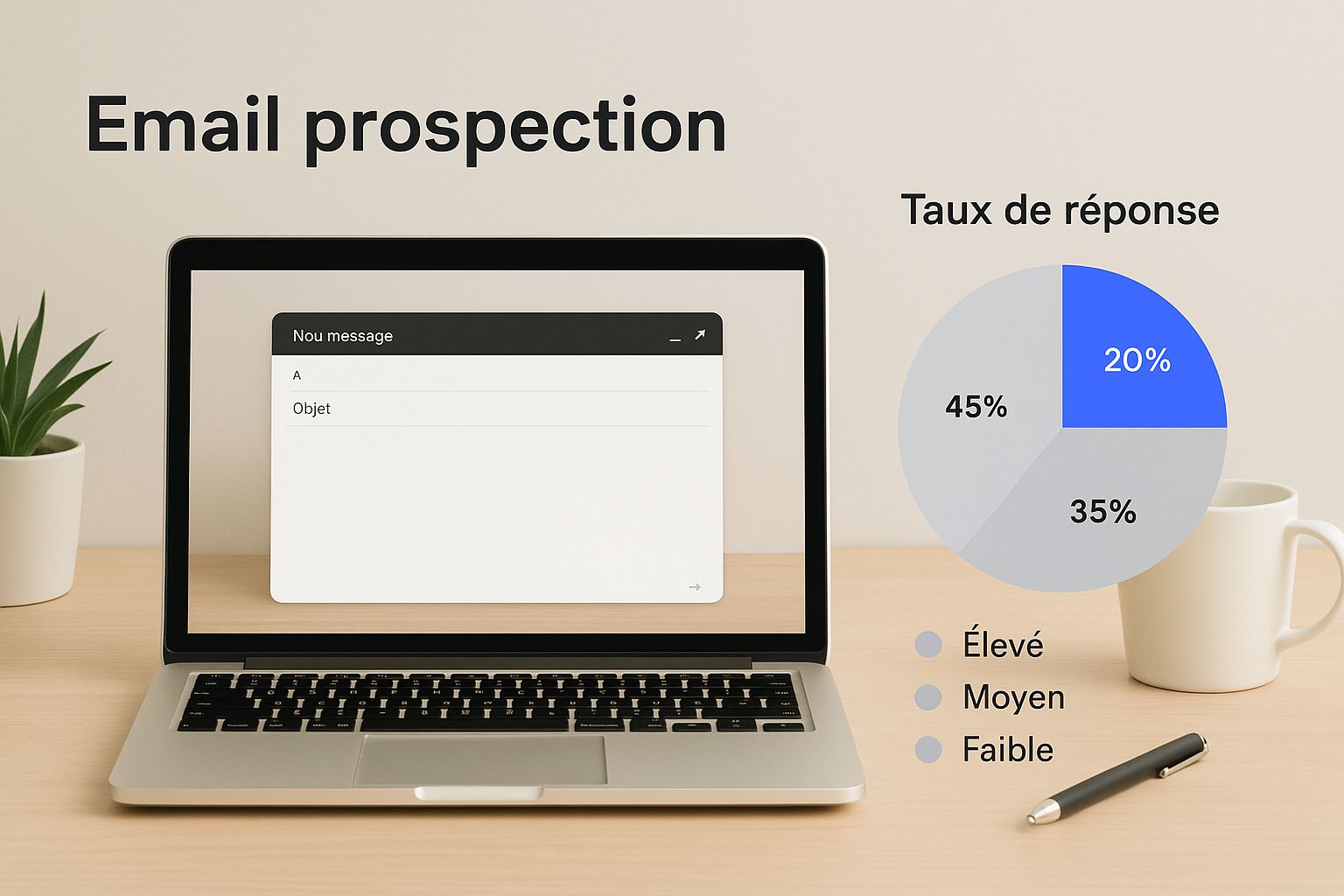
We can clearly see here that emailing serves as a pillar, both to launch contact, automate reminders and, above all, to measure what works.
H3 The Classic Duel: Email vs Phone
Email and telephone are the two historical pillars of B2B prospecting. Rather than seeing them as rivals, it's better to think of them as two teammates with different skills.
The quiet power of email
Email is the marathon runner in prospecting. It is the perfect tool to contact a large number of people in an automated way, without sacrificing personalization. It makes it possible to initiate contact gently, to nourish the interest of the prospect and to remain present in their mind, all without being too intrusive.
Its main advantages:
- Scaling up: Whether you contact 10 or 10,000 people, the effort is minimal with the right tools.
- Precise analysis: Opening rate, click rate, response rate... everything is measurable. This allows you to adjust your strategy continuously.
- Flexibility: The prospect reads and replies when they want. It is an approach that respects its agenda.
When you look at the different methods of B2B prospecting, email stands out because of its effectiveness on a large scale. Use effective business email templates can also make a real difference in your response rates.
The direct impact of the telephone
The telephone is the sprinter. To create an immediate human connection, obtain candid answers and qualify an in-depth contact, he is unbeatable. A well-conducted call can do in five minutes what ten emails will never be able to do: create a real dialogue. To dig deeper into the subject, feel free to read our complete article explaining What is B2B prospecting.
A phone call allows you to grasp things that the written word does not convey: hesitation, an enthusiastic tone of voice... It is the channel for emotion and conviction.
In France, the numbers speak for themselves. On average, 31% of prospecting emails are opened and half of the customers (50%) appreciate receiving offers in this way. On the telephone side, a salesperson spends on average 52 calls per day, and it's a channel that converts: 45% of prospects contacted become customers, and more than 81% of sales are signed after the fifth call. Perseverance pays off!
To help you visualize the strengths of each approach, here is a simple comparison chart.
Comparison of B2B prospecting methodsThis chart compares email, telephone, and multi-channel approaches according to key criteria to help choose the best strategy.
Criteria: Email prospecting, telephone prospecting, Multi-channel approachCostLow Moderate Variable (often high)RapidityVery quick to deploy/Time consumer/Planning requiredPersonalizationModerate to high (with tools) Very highVery highInteractivityLow (asynchronous) Very high (instantaneous) High (synchronized)ScalabilityVery high/low/moderateROI measurementEasy and accurateMore complex to trackerComplex but complete
Each method has its place, but as the table shows, it is their combination that offers the most potential.
The multi-channel approach: the symphony of prospecting
The real magic happens when these channels stop playing solo and form an orchestra. The multi-channel approach is more than just “doing a little bit of everything.” It means integrating these actions into a logical and coherent sequence.
Imagine this scenario:
- Email #1: You send a first personalized contact that highlights a specific problem for your prospect.
- Action on LinkedIn: A few days later, you add the person to your network with a note that refers to your email.
- Phone call: You're not calling to sell, but to discuss the content shared in the first email.
- Email #2: You send a follow-up email that builds on your conversation, along with a relevant case study.
With this approach, prospecting becomes a conversation. Each step justifies the next, which makes the exchange much more natural. You are no longer a salesperson who interrupts, but an expert who accompanies.
Mastering telephone prospecting in the digital age
We often hear that the telephone is an outdated prospecting tool, swept away by emails and social networks. It is a mistake. In the hands of a salesperson who knows how to use it, direct contact by voice remains a powerful weapon, especially when it comes to complex sales where trust is the keystone of the entire relationship.
The real magic of the telephone is not to write out a script learned by heart. It's about succeeding in forging a human connection in just a few seconds. It is the only channel that allows you to feel the nuances in the voice of your interlocutor, to perceive hesitation or an impulse of enthusiasm. These are all valuable clues to adjust your live speech.
Skills that make a difference, far beyond the script
The success of a call does not depend so much on the tool as on the mastery of specific human skills. The real challenge is not to make more calls, but to make each call more significant. Good training on these points can turn a good sales team into a real closer machine.
Core competencies boil down to:
- Active listening: It's not just about hearing the prospect's words. You have to look for what is behind it: your real needs, your frustrations, your motivations. A great salesman doesn't talk much, but he listens a lot.
- The art of asking the right questions: Knowing how to ask open and relevant questions is what differentiates a productive conversation from an awkward interview. This is what makes it possible to qualify a prospect quickly and to guide the exchange intelligently.
- Creating an instant connection: To do this, you have to find a common ground, show genuine empathy and adapt your tone. This is what makes it possible to establish a climate of trust from the very beginning.
Telephone prospecting is an art that can be learned. The best salesperson is not the one with the best arguments, but the one who knows how to create a real dialogue to understand and solve the problem of the interlocutor.
These skills are all the more vital as decision-makers' attention span is now very limited. You have to succeed in capturing their interest and prove your value in record time.
A strategic challenge for sales teams
Mastering these techniques remains a major challenge for many businesses. A recent study, conducted in France with more than 4,000 companies contacted, highlighted an essential fact: precise targeting, quality contact and good telephone qualifications are the skills that really make the difference. The study also shows huge differences in performance between teams, which shows a pressing need for more modern and better targeted training. To find out the details of this analysis, you can consult the study on telephone prospecting skills in France.
This confirms that the problem is not the phone itself, but the way it is used.
The telephone becomes even more formidable when it is integrated into a multi-channel strategy. A call can perfectly follow an email to add a human touch, or on the contrary precede the sending of a personalized document to increase its impact tenfold. It is this synergy between channels that makes prospecting fluid and effective, making a simple call a decisive step in the buying journey.
Best practices and common mistakes to avoid

Knowing the different prospecting methods is good. But to turn this knowledge into appointments and customers, you have to move on to practice. This is where the devil is in the details, and where the difference is between a campaign that takes off and one that remains grounded.
Adopting best practices isn't just about being polite; it's what will make you stand out at a time when decision-makers are overwhelmed with messages. In the same way, knowing how to identify and correct the most common mistakes is the best shortcut to boost your results.
The keys to successful prospecting
For every action to really count, it's often enough to focus on a few well-proven fundamentals. Think of these practices as the basis for an approach that is both more human and much more effective.
Personalize, without spending the dayPersonalization is the queen of modern prospecting. A message that shows that you've done a minimum of research will always resonate much louder than a generic email sent on the fly.
- What to do: Mention a recent LinkedIn post from your contact, news about their company, or a challenge specific to their sector. Dynamic fields such as first name or company are a good base, but a real custom catchphrase changes everything.
- What not to do: Send the same template to hundreds of people by just changing the name. Your prospects are not fools, and you can feel that they are miles away.
Knock at the right timeTiming can make all the difference. Contacting a prospect when they are the most available and receptive means putting every chance on their side to get a response.
Studies confirm it: the best times to send a prospecting email are Tuesday and Thursday, ideally between 10 am and 11 am. For a call, prefer the end of the morning or the beginning of the afternoon.
Relaunch to help, not to harassPerseverance pays off, but only if you are smart. A good reminder is not a simple repetition, it brings value every time. This reinforces your image as an expert, not that of a hard-pressed salesperson.
After initial contact, let a few days pass. Vary the channels (an email, then a message on LinkedIn, then a call) and the content. For example, after a presentation email, why not share a case study relevant to your business? Prospecting is a marathon, not a sprint.
The classic mistakes that kill your campaigns
Even with the best intention in the world, some mistakes can ruin all your efforts. The first step to progress is to identify them in order to permanently remove them from your routine.
Don't measure what works (or doesn't)“What can't be measured doesn't get better.” This sentence is a bit cliché, but so true in prospecting. Without monitoring your performance indicators (KPIs), you are moving completely blindly.
- Response rate: How many people are responding to your messages?
- Conversion rate: How many contacts turn into qualified appointments?
- Performance by channel: Where do your best leads come from? The email? The phone?
Analyzing these numbers allows you to adjust your prospecting method all the time and to put your energy where it really matters.
Lack of persistence after a “no”A refusal or a lack of response does not always mean “never.” More often than not, your interlocutor is just overwhelmed. It is estimated that on average it is necessary 8 to 12 contact points to start a real conversation. Giving up too quickly is simply leaving money on the table.
In fact, once the interest is there, the final step to close the sale is an art in itself. To go further on this point, take a look at our 10 techniques to close sales quickly and transform your prospects into loyal customers.
Talk about yourself instead of talking about themYour prospect is laughing at your product. What he is interested in are his own problems. One of the most common mistakes is starting the conversation by scrolling down the list of features in your solution.
Think more like a consultant. Ask questions, really listen to the answers, and only then show how your offer can solve a real pain or help them achieve a specific goal. Your goal is not to sell at all costs, but to understand and to help. The sale will follow naturally.
Integrate tools to automate your prospecting
One prospecting method Well established, that's your battle plan. But technology is the arsenal that allows you to deploy it on a large scale. Attention, the idea is not to replace the human by the machine, quite the contrary. The goal is to free your salespeople from thankless and repetitive tasks so they can focus on where they excel: building relationships and having conversations that matter.
Imagine for a moment a salesperson who no longer spends his days copying and pasting emails or desperately looking for the history of a prospect. That is precisely the promise of automation. It takes a good strategy and turns it into an efficient and, above all, predictable sales machine.
Save valuable time through automation
The most obvious benefit of automation is time savings. Modern platforms can handle personalized email sequences, schedule call reminders, and even trigger specific actions based on a prospect's behavior (does he open an email? he clicks on a link?).
This regained time is far from being anecdotal. A salesperson can then devote himself to tasks that require real emotional intelligence and business expertise:
- Prepare your discovery appointments in depth.
- Adapt your demonstrations so that they really speak to the customer.
- Negotiate and close the most complex deals.
In short, automation manages the volume, while the human takes care of the value.
Centralize data for a 360° view
Without the right tools, information about your prospects often ends up scattered: a note in a notebook, an email lost in an inbox, a detail stolen during a call... One CRM (Customer Relationship Management) or a prospecting platform like Oliverlist acts as a central brain for all this data.
Every touchpoint, every response, every objection is recorded in the same place. This gives you a complete and instant view of each lead's history, and allows anyone on the team to take over without losing track.
This centralization is the key to coherent prospecting. It ensures that your message always remains relevant and perfectly adapted to the journey of your future customer. To go further and truly transform your approach, it is essential to equip yourself. Take a look at best marketing automation tools to identify the solution that will boost your efficiency. Analyzing the results will then become your best asset to refine your strategy continuously.
Frequently asked questions about commercial prospecting
As we know, embarking on commercial prospecting can quickly make your head turn. There are so many questions that are jostling! To help you see things more clearly and build a solid strategy, we've put together the most common questions here.
What is the best prospecting method in B2B?
If only there was a magic answer! But the truth is that the “best” method doesn't exist. The most effective strategy will always be the one that is best suited to your reality.
In practice, the approach that gives the best results is almost always a well-thought-out multi-channel strategy. It's about intelligently combining several channels to increase the chances of reaching your target audience.
Imagine that you are preparing a dish. Success doesn't come from a single miracle ingredient, but from the perfect balance between multiple flavors. For prospecting, it's the same. Your recipe should mix:
- The reach of email, ideal for reaching a large number of people in a semi-automated way.
- The direct impact of the telephone, perfect for creating a real human connection and asking the right questions.
- The credibility of social networks like LinkedIn, which allows you to establish your expertise and get noticed.
The right mix will depend on your industry, the complexity of what you're selling and, above all, the habits of your ideal customer. The key is to create a logical journey where each interaction reinforces the previous one, offering a natural experience for your prospect.
How many touchpoints do you need to convert a lead?
The numbers speak for themselves: on average, you need between 8 and 12 points of contact to make a prospect switch to B2B. But beware, the most important thing is not the number, but the relevance of each interaction.
Intelligent follow-up, which adds value to each message, will have a thousand times more impact than ten generic reminders sent blindly.
The secret is to vary the pleasures. Alternate channels (an email, a call, an interaction on LinkedIn) and messages (sharing a relevant article, inviting a webinar, presenting a case study...). That way, you stay in their mind without ever giving the impression of forcing a hand.
How to measure the success of your commercial prospecting?
To find out if your efforts are paying off, you need to follow the right performance indicators (KPIs). This will allow you to understand what really works and to adjust the situation constantly, instead of navigating by sight.
In concrete terms, here are the metrics you should focus on:
- The number of qualified leads that you generate.
- The conversion rate at each stage (email response rate, appointment rate obtained, etc.).
- The customer acquisition cost (CAC) to make sure your efforts pay off.
- La customer lifetime value (LTV) to measure the return on investment over the long term.
Analyzing these figures rigorously means turning prospecting into a science. This gives you the tools you need to constantly improve your results.
Ready to take things to the next level and fill your salespeople's calendars with quality appointments? Oliverlist takes care of your multi-channel prospecting from A to Z. Discover how we can generate concrete results for you on https://www.oliverlist.com.
Article created using Outrank